Best Home AC Leak Detector for Quick, Accurate Refrigerant Checks
If you’re hunting for a reliable home AC leak detector, you want a tool that quickly identifies halogen refrigerants, is easy to use, and works in tight spaces. The top options below are suited for DIY homeowners, automotive enthusiasts, and HVAC helpers who need portable, cordless, or versatile detection. Each pick targets specific needs—whether you want long sensor life, high sensitivity, or dual detection modes.
The table below summarizes five strong choices, highlighting who they’re best for and a quick note on their strengths.
| Product | Best For | Why It Stands Out |
|---|---|---|
| Elitech Freon Leak Detector WJL-6000S | Homeowners who need a general-purpose detector | Adjustable sensitivity; audible/visual indicators; supports all halogenated gases |
| Elitech ILD-200 | Those seeking fast response and broad gas detection | Infrared sensor; high interference resistance; detects all halogenated gases |
| SENSYX SFD200 | Cordless convenience and portability | Rechargeable battery; compact; reliable high sensitivity |
| Elitech CLD-100 | Difficult-access areas and fast preheating | Flexible probe; quick triggers on common refrigerants |
| SENSYX SFD201 | 2-in-1 détecteur for leaks and combustible gases | Rechargeable; versatile sensor |
Elitech Freon Leak Detector WJL-6000S

Best for: Home HVAC setups and auto AC inspections where frequent leak checks are needed. This model detects all halogenated refrigerants, including R22, R134A, R404A, R410A, and R1234YF, making it versatile for many systems. Sensitivity is adjustable up to 0.21 oz/yr, enabling both quick spot checks and finer leak pinpointing. It includes audible and visual indicators and dual battery indicators to ensure you won’t miss a leak in dim conditions or during power fluctuations.
Why selected: The broad gas compatibility combined with adjustable sensitivity makes it a practical all-around detector for homeowners who service multiple appliances. It’s particularly helpful for auto AC owners who want a compact, easy-to-use tool with clear alerts.
Caution: If you’re in a particularly noisy environment, rely on the visual indicators and consider using the dual battery readout to avoid running out of power mid-check.
Elitech ILD-200 Infrared Leak Detector
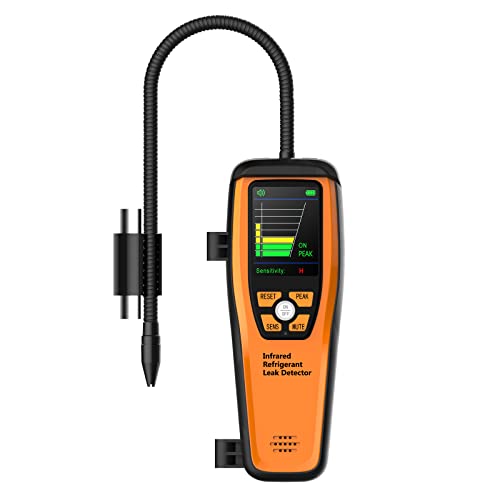
Best for: Users who need high accuracy with strong anti-interference performance and comprehensive halogen gas detection. The infrared sensor provides fast response time and lower false positives compared to heated diodes, with a maximum sensitivity of 0.14 oz/yr.
Why selected: Its robust sensor technology and broad gas coverage make it ideal for frequent, precise checks in complex HVAC systems, including blends and newer refrigerants. It’s well-suited for technicians who require quick, reliable readings in varied environments.
Caution: Infrared sensors can be slightly more sensitive to ambient temperature changes; allow the unit to acclimate in very cold or hot spaces for best accuracy.
SENSYX SFD200 Rechargeable HVAC Detector

Best for: Cordless operation where mobility and quick hand checks are essential, such as in attics, basements, or automotive trunks. It uses a highly sensitive Japanese-made heat dioxide semiconductor sensor and offers adjustable sensitivity with High/Low settings.
Why selected: The USB-C rechargeable design and compact form provide convenient, on-the-go leak detection without constant power access. The sensor’s reliability supports consistent performance across different refrigerants.
Caution: Although cordless, ensure the battery is kept charged to avoid interruptions during multi-location checks.
VIVOHOME HVAC Freon Leak Detector

Best for: Users looking for universal compatibility and a strong audible/visual alarm system in noisy environments. It detects all halogenated refrigerants, including R134a, R410a, R32, and R1234yf, plus CFCs and HCFCs, with seven sensitivity levels and a 85dB alarm for tough spaces.
Why selected: The bendable 7.9-inch probe helps reach tight engine bays and compressor seals, and the dual-color LED work light enhances visibility in dark areas. This makes it a versatile choice for automotive and home HVAC tasks.
Caution: In extremely loud settings, rely on the unit’s visual indicators and the LED light to confirm a leak when the audible alarm competes with background noise.
Lichamp AC Leak Detector Kit LA01

Best for: Home users who want a complete UV dye kit for broader leak detection including hidden leaks, with a UV flashlight designed for higher visibility of dye traces.
Why selected: The 2-in-1 design doubles as an AC leak detector and a UV dye tracer, enabling detection of leaks that aren’t immediately visible. The durable UV flashlight and protective glasses enhance safety and accuracy in various environments.
Caution: Dye-based detection can require post-check cleaning to prevent residue buildup on sensitive components.
Aprvtio WJL-6000PRO 3-in-1 Leak Detector

Best for: Professionals and serious hobbyists who need dual detection modes and an all-metal probe for rugged use. It offers PPM and %LEL readings to cover ultra-sensitive leak checks and safety monitoring of A2L refrigerants.
Why selected: The dual-detection approach provides granular data and safety context, while the all-metal probe improves durability in dirty or challenging work sites. Audible and visual alarms with a mute option support varied environments.
Caution: The dual-mode display requires familiarization to interpret PPM versus %LEL readings accurately for complex refrigerant blends.
Buying Guide: How to Choose the Right Home AC Leak Detector
- Refrigerant coverage: Ensure the detector reads all refrigerants you encounter—R410A, R134A, R22, R1234YF, and blends. Some models also detect CFCs and HCFCs.
- Sensitivity and range: Higher sensitivity helps locate tiny leaks, but may increase false alarms in drafts or cold spaces. Look for adjustable levels (Low/Medium/High) and a clearly defined max reading.
- Sensor type: Infrared sensors tend to resist interference and offer quick responses, while traditional corona or heated diode sensors can be more affordable but sensitive to ambient conditions.
- Form factor and accessibility: Flexible probes or long lengths help in tight engine bays or HVAC cabinets. Consider cordless models for mobility or plug-in units for uninterrupted use.
- Audible vs. visual alerts: In noisy environments, robust visual indicators and bright LEDs can be essential. Some units offer mute options for quiet indoor checks.
- Power and durability: Rechargeable batteries provide mobility; ensure battery life matches your usual workflow. Probes and housings should be durable for frequent use.
- Additional capabilities: Some detectors double as dye testers with UV lights, or offer dual detection modes like PPM and %LEL for specialized work with A2L refrigerants.
FAQ
- What is a home AC leak detector used for?
It helps locate refrigerant leaks in automotive AC systems and home HVAC units by detecting halogen refrigerants in the air.
- Do all detectors work with R1234YF?
Most modern detectors detect common halogen refrigerants, including R1234YF, but check the product features to confirm they support your specific refrigerant.
- What’s the advantage of an infrared sensor?
Infrared sensors typically offer faster response and better resistance to interference, improving accuracy in busy environments.
- Should I choose a 2-in-1 leak detector?
If you also need to detect combustible gases or perform dye-based inspections, a 2-in-1 model adds versatility for comprehensive leak checks.
- How important is probe length?
A longer or flexible probe helps reach tight spaces like compressor seals or engine bays, reducing the need to disassemble components.
- Can I rely on audible alerts alone?
Audible alerts are helpful, but visual indicators and displays provide more precise leak readings, especially in loud environments.