Best Floor Vent Filter Options to Improve Air Quality
Looking for a reliable filter for floor vents? This guide highlights practical 4″ x 10″ and nearby sizes, explaining who each product is best for and why. These vent filters are designed to balance airflow with filtration, helping reduce dust, allergens, and odors in living spaces. The selections below are suited for homeowners, renters, and DIY enthusiasts aiming to improve indoor air without overtaxing HVAC systems.
The following table summarizes the five featured products, including size compatibility and what type of buyer each is best for. Use it as a quick reference when deciding which vent filter to buy.
| Product | Size | Best For | Why It Stands Out |
|---|---|---|---|
| NORTHWEST ENTERPRISES Vent Filters, 24 Floor Vent Register Filters | 4″x10″ | Budget-conscious homes | Simple polyester filtration with solid airflow balance |
| NORTHWEST ENTERPRISES Vent Filters, 48 Floor Vent Register Filters | 4″x12″ | Homes with larger vents | Electrostatic filtration and compatibility with ceiling vents |
| UCandy 4″x10″ Activated Carbon Air Vent Filters | 4″x10″ | Odor-prone rooms | Charcoal carbon for odors and VOC reduction |
| NORTHWEST ENTERPRISES Vent Filters, MERV 8 Electrostatic Triple Filtration | 4″x10″ | All-around filtration with extra layers | MERV 8 triple filtration with electrostatic media |
| Activated Carbon Air Vent Filters for Home | 4″x10″ | People needing carbon filtration in multiple rooms | 24-pack option for broader coverage |
NORTHWEST ENTERPRISES Vent Filters, 24 Floor Vent Register Filters

Best for: Budget-minded homes needing straightforward filtration. This 4″x10″ filter uses 100% polyester to trap common airborne particles, helping reduce sneezing and itchy eyes from dust and pollen. It balances filtration with airflow to avoid stressing HVAC systems.
Why chosen: It offers practical daily filtration at a lower cost, ideal for replacement frequency every 90 days. Cautions: Those requiring heavy odor or VOC control may want extra carbon filtration.
NORTHWEST ENTERPRISES Vent Filters, 48 Floor Vent Register Filters

Best for: Homes with larger or multiple floor vents needing consistent filtration across rooms. This 4″x12″ option emphasizes enhanced airflow while keeping particles to a minimum.
Why chosen: Engineered for better airflow and filtration, it supports ceiling vents as well and can be repurposed for DIY scenting with essential oils. Caution: If space is tight, ensure a precise 4×12 fit to avoid gaps that bypass filtration.
UCandy 4″x10″ Activated Carbon Air Vent Filters

Best for: Rooms where odors or VOCs are a concern. These 4×10 charcoal filters capture odors and pollutants in addition to dust, improving perceived air freshness in kitchens, living areas, and pet zones.
Why chosen: The activated carbon component adds odor control and VOC reduction, which is a practical upgrade over basic filtration. Limitation: Charcoal filters can be slightly more expensive and may require more attentive replacement scheduling for best results.
NORTHWEST ENTERPRISES Vent Filters, MERV 8 Electrostatic Triple Filtration

Best for: Homes seeking enhanced filtration in a compact 4″x10″ footprint. The triple-layer electrostatic design aims to capture more particles while maintaining airflow.
Why chosen: Multi-layer filtration adds defense against dust, pollen, and small particulates. Caution: The premium filtration may require more frequent changes in dust-heavy environments to maintain efficacy.
Activated Carbon Air Vent Filters for Home – 4″ x 10″
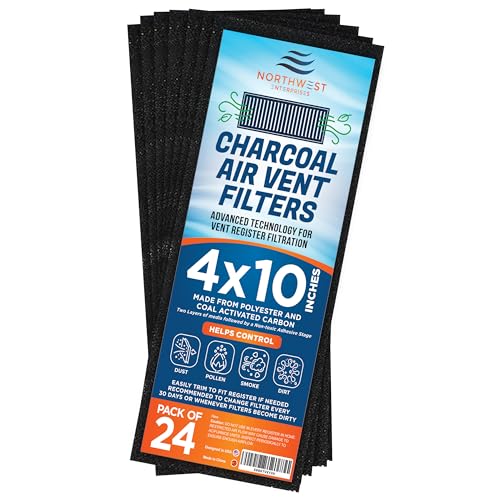
Best for: Broad coverage across multiple rooms with a carbon-focused solution. Available in a 24-pack, this option is suited for homeowners who want steady carbon filtration across several vents.
Why chosen: The carbon filters actively remove odors and VOCs while balancing airflow. Buy in bulk to minimize replacement gaps in larger homes. Caution: Verify vent fitment for 4″ x 10″ dimensions to avoid undersized gaps that bypass filtration.
Buying Guide: How to Choose Floor Vent Filters
- Vent size compatibility: Most common sizes are 4″ x 10″ or 4″ x 12″. Confirm your vent dimensions before purchasing.
- Filtration type: Basic polyester filters capture dust and pollen; activated carbon adds odor and VOC control; multi-layer electrostatic designs balance filtration with airflow.
- Airflow impact: Look for filters described as balancing filtration and airflow to avoid stressing HVAC components.
- Maintenance cadence: 90-day filtration claims are common; however, high-dust environments may require more frequent changes.
- Versatility: Some filters fit ceiling vents or other register styles; consider whether you want one solution for multiple vent types.
- Odor control: Carbon or activated-carbon options are better for kitchens, pet areas, or smoke-prone spaces.
FAQ: Floor Vent Filter Questions
- Q: Do floor vent filters significantly reduce dust in all rooms? A: They reduce airborne dust near vents; overall household dust may still require regular cleaning beyond vent filtration.
- Q: Can I cut filters to fit nonstandard vent sizes? A: Some products are cut-to-fit or designed for easy trimming with scissors; check product details before buying.
- Q: Do carbon filters produce any odors themselves? A: Carbon filters help absorb odors rather than emit them, but replacement timing is important for ongoing effectiveness.
- Q: Will carbon filters affect HVAC efficiency? A: When properly sized, carbon filters can balance filtration with airflow without excessive resistance.
- Q: Are these filters easy to install for DIY renters? A: Yes, most 4″ x 10″ and 4″ x 12″ vent filters are designed for simple replacement without special tools.
- Q: How often should I replace vent filters in a high-dust home? A: In dusty environments, consider checking every 4 to 8 weeks and replacing around every 2-3 months.