Best Fans That Move the Most Air for Quick Cooling
If you need fast, noticeable cooling, pick fans designed to move a lot of air. This guide highlights five high-airflow models suited for bedrooms, living rooms, offices, and workshops. Ideal buyers: the Hurricane box fan for large spaces; tower fans for slim spaces with strong airflow; portable high-velocity units for quick spot cooling; and quiet options for bedrooms. Below is a quick product comparison to help you decide which works best for your space and budget.
| Product | Estimated Airflow Focus | Best For | Notes |
|---|---|---|---|
| Hurricane Classic Floor Mount Box Fan, 20″ | High CFM (2400) practical for whole-room circulation | Large rooms, garages, basements | Three speeds, solid overall performance |
| DREO Tower Fan, 42″ High | Up to 1473 CFM with fast airflow | Living rooms, tall ceilings, home offices | Quiet operation, multiple modes |
| DREO Fan for Bedroom, 12″ Table | Up to strong airflow for small to medium rooms | Desks, nightstands, dorm rooms | Quiet at 25dB typical |
| Lasko High Velocity Portable Utility Fan, 12″ | Up to 289 CFM with three speeds | Spot cooling in bedroom/office | Adjustable pivot; built-in outlets |
| Lasko Wind Machine Fan, 20″ | Three speeds with powerful output | Floor cooling for living areas | Pivots for targeted airflow |
Hurricane Classic Floor Mount Box Fan

The Hurricane Classic Floor Mount Box Fan delivers substantial airflow with 2400 CFM capacity and 1100 RPM. It is a practical choice for larger rooms, garages, or workshops that require a steady breeze. Three quiet speed settings help tailor airflow without excessive noise. This model is best for buyers prioritizing raw air movement and consistent circulation over ultra-quiet operation. A limitation is that it lacks built-in outlets, so you’ll rely on nearby outlets for devices.
DREO Tower Fan for Bedroom, 42-Inch

This 42-inch DREO tower fan uses a high-speed DC motor delivering up to 1473 CFM and rapid airflow across the room. It features 9 speeds and 4 modes (Standard, Natural, Sleep, Turbo) for customizable cooling. With a 20dB quiet operation and a dimmable display, it’s well-suited for bedrooms and living areas where you want strong air movement with minimal disruption. A potential limitation is its taller footprint, which might dominate smaller spaces.
DREO Fan for Bedroom, 12-Inch Table
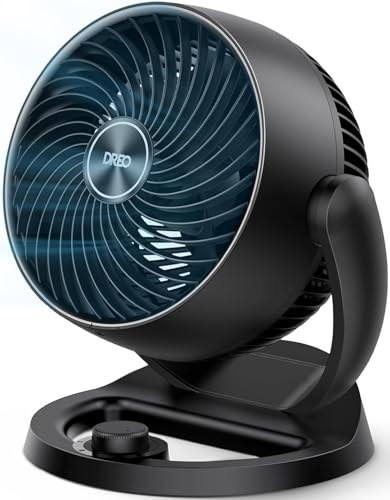
The 12-inch DREO table fan focuses airflow for desks and bedside setups. It claims a strong “WingBoost” style circulation that can move air effectively across a small-to-medium room. Noise levels are kept low (about 25dB), making it a sensible option for bedrooms and offices where quiet operation matters. Choose this if you need portable, discreet airflow rather than full-room circulation.
Lasko High Velocity Portable Utility Fan

This 12-inch Lasko unit emphasizes compact power with adjustable airflow. It delivers up to 289 CFM across three speeds, and its pivoting design directs air where needed—ideal for drying floors or cooling workspaces. It includes two built-in grounded outlets, making it convenient for plugging in tools or devices nearby. Better for targeted cooling than entire-room circulation; not the best pick if you need full-room airflow.
Lasko Wind Machine Fan, 20″

The Lasko Wind Machine is a floor fan designed for robust airflow in larger rooms. It features three speeds and a pivoting head to direct air where needed. It’s a solid option for living rooms or open-plan spaces where you want a strong breeze across a wide area. The main limitation is that it is less compact than box or tower models and may be less convenient in tight spaces.
Buying Guide
What to consider when choosing high-airflow fans:
- Room size and layout: Large rooms benefit from box fans or tall tower models to cover more area quickly; small spaces suit compact high-velocity fans.
- Airflow vs. noise: Higher CFM often means more noise. Look for models with quiet operation modes or DC motors for evenings or bedrooms.
- Portability vs. fixed placement: Box fans and table fans offer flexible placement; tower fans save floor space and often deliver steady airflow.
- Power features: Fans with built-in outlets or remote controls add convenience, especially in bedrooms or offices.
- Durability and maintenance: Metal housings and robust blades can withstand frequent use; check for easy cleaning and blade access.
Frequently Asked Questions
- What is considered “high airflow” for a fan?
High airflow is typically described in CFM (cubic feet per minute) and speed settings. Box fans and high-velocity units often range from several hundred to over a thousand CFM, depending on size and motor type. - Are taller tower fans better for moving air across a room?
Tower fans can distribute air from a distance and cover longer sightlines, but overall airflow depends on motor strength and blade design rather than height alone. - Should I prioritize louder high-CFM fans or quieter, mid-CFM models?
For bedrooms or study areas, prioritize quiet operations (DC motors, sleep modes). For workshops or garages, higher CFM with acceptable noise may be preferable. - Do fans with built-in outlets offer real benefits?
Yes, built-in outlets can reduce the number of extensions needed, but verify outlet wattage limits to avoid overloading. - Can these fans help with energy savings?
Airflow improves cooling distribution and can reduce the need for air conditioning, potentially lowering energy use when used as a supplement.