Best Small Bedroom Fans for Quiet, Effective Cooling in Limited Spaces
Answering the need for compact, quiet, and efficient cooling, these small-bedroom fans offer portable solutions that fit on a nightstand, desk, or closet shelf. They’re ideal for college dorms, apartments, and guest rooms where space is tight. The top picks below emphasize low noise, focused airflow, and easy positioning to suit sleeping, working, or relaxing. The list highlights buyers who want reliable personal comfort without clutter or disruption.
| Product | Best For | Why Chosen |
|---|---|---|
| Honeywell HT900 / HT-904 | Small desks, nightstands | Quiet, compact, 3 speeds, 90° head pivot for targeted cooling |
| Amazon Basics Air Circulator Desk Fan | Budget-friendly small spaces | Simple design, 3 speeds, 90° tilt, minimal footprint |
| KopBeau Personal Tower Fan | Desk-to-dorm transitions | Cable-friendly, 3 speeds, 60° and 110° oscillation options |
| DREO 12-Inch Table Fan | Medium rooms, night-friendly | Long reach air movement, low 25dB noise, energy-efficient |
| Levoit Tower Fan (12-Hour Timers) | Sleep-friendly bedrooms | Whisper-quiet with timer, auto-adjusting airflow |
Best Honeywell HT900 TurboForce Air Circulator

Features include a small floor or tabletop design and three speeds with a 90° pivoting head. The aerodynamic turbo design powers air movement for strong cooling or energy-saving circulation. It’s marketed as 25% quieter than comparable fans and is suitable for small to medium-sized rooms. Best for: users who want a compact, high-power option that can be positioned for focused airflow on a desk or bedside table. Limitation: power is optimized for closer distances; airflow diminishes at far distances in larger spaces.
Amazon Basics Air Circulator Desk Fan

Compact desk fan with a 90-degree tilt head and three speeds. The design emphasizes minimal footprint, making it easy to place on a nightstand or small desk. Best for: budget-conscious buyers seeking straightforward airflow without extra features. Limitation: fewer advanced controls or smart features compared to higher-end models.
KopBeau Personal Tower Fan

This standing fan offers 60° and 110° dual oscillation, with three speeds and a compact tower form. It’s designed to be a versatile option for bedrooms, offices, or dorms where wider reach and flexible airflow are desired. Best for: users who want adjustable direction for both close personal cooling and full-room coverage. Limitation: may be more visually tall than some ultra-compact models, requiring room for full oscillation.
DREO 12-Inch Table Fan
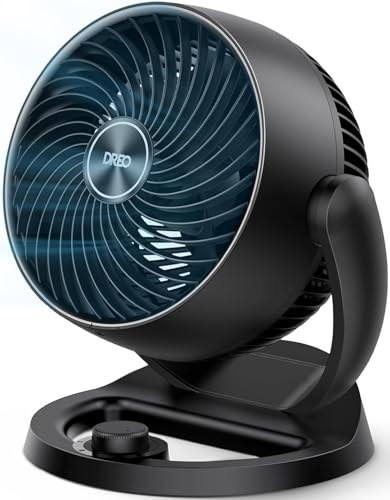
With WingBoost airflow and a 12-inch blade size, this fan claims up to 70 feet reach in airflow and noise as low as 25dB. The 120° tilt adds versatility for directing air toward a bed or workplace. Best for: bedrooms needing quiet operation and broad distribution. Limitation: larger footprint than micro desk fans; airflow depends on room layout.
Levoit Tower Fan for Bedroom (DC Motor)

Bladeless design with a DC motor delivers efficient airflow, with 20–43dB noise levels across speeds. It features a 12-hour timer and portable handle for room-to-room use. Best for: sleepers who value near-silent operation and smart time-based cooling. Limitation: bladeless design can come with a higher price point and fewer tactile controls than traditional blade fans.
Buying Guide: What To Consider When Choosing A Fan For A Small Bedroom
- Noise level: For bedrooms, prioritize fans with low decibel ranges and quiet operation to support sleep. Look for 20–40dB ranges or labeled “quiet” or “sleep mode.”
- Airflow reach and direction: If the space is tightly confined, a model with adjustable tilt, 90° or wider oscillation, and a pivoting head helps you direct air precisely where you want it.
- Size and footprint: Measure your nightstand or desk depth to ensure the unit won’t crowd the space. Ultra-compact models fit standard tabletops; taller tower fans can offer better air distribution in small rooms.
- Power and energy: DC motors improve efficiency and reduce noise at low speeds. Consider timers for overnight use to avoid wasting energy.
- Ease of use: Simple controls, remote options, and straightforward setup are beneficial for quick daily use in bedrooms and offices.
- Durability and maintenance: Removable grills and easy-clean blades extend usability. Check for washable filters or accessible parts if you value ongoing cleanliness.
Frequently Asked Questions
- What size fan is best for a small bedroom?
– A compact desk fan or a 12–14 inch table fan often provides sufficient airflow without overwhelming the space. - Are bladeless fans better for bedrooms?
– They’re typically quieter and easier to clean, but prices are higher; choose based on noise preferences and budget. - Should I choose a oscillating fan for a small room?
– Yes, oscillation improves air distribution across the room, especially in rooms with seating or sleeping areas off-center from the fan. - Is a DC motor fan worth it for bedrooms?
– Yes, DC motors generally run more quietly and efficiently at low speeds, which is beneficial for sleeping environments. - Do these fans require frequent maintenance?
– Most entry-level models require only periodic dusting and simple cleaning of grills; follow the manufacturer’s cleaning guidance. - Can I mount these fans on a wall?
– Some models support wall mounting, but check the product’s designed use and mounting options before installation.