Best Fans That Blow Cold Air for Any Space
Answering the search for a fan that blows cold air, these products are selected to suit different rooms and needs. Ideal for shoppers seeking quiet operation, strong airflow, and reliable cooling across bedrooms, offices, and living spaces. The top picks include models with high velocity air, whisper-quiet operation, and adjustable features for precise comfort. Below, you’ll find five options with clear strengths and practical buying cues.
| Product | Best For | Key Benefit |
|---|---|---|
| DREO 2026 Upgraded DC Motor Tower Fan | Nighttime sleep and work desks | High velocity with quiet operation |
| Levoit 36-Inch Tower Fan | Whole-room cooling | Auto-adjusts with temperature sensor |
| DREO 90° Oscillating Tower Fan (26 ft/s) | Living rooms and larger spaces | Wide oscillation with strong airflow |
| DREO 42-Inch Tower Fan (28 dB, 26 ft/s) | Quiet bedrooms or offices | Low noise with powerful cooling |
| KopBeau Personal Tower Fan | Small spaces or desk use | Flexible oscillation and compact design |
DREO 2026 Upgraded DC Motor Tower Fan

Best for: Nighttime sleepers and quiet work areas. This model uses an upgraded DC motor and TurboWind technology to deliver airflow up to 28 ft/s and coverage up to 34 ft. It emphasizes low noise, at about 20 dB, making it suitable for bedrooms and quiet offices. The fan supports 8 speeds and 4 modes, controlled via remote or touch screen. Caution: Some users may find the learning curve for multiple modes longer at first use.
DREO 90° Oscillating Tower Fan With 26 Ft/s Air

Best for: Large living spaces and open-plan rooms. With 26 ft/s airflow, this model provides broad coverage and a 90° oscillation to circulate air efficiently. It offers 4 modes and 5 speeds, with a 12-hour timer available via remote. Caution: Read the remote control instructions to ensure proper mode selection for optimal comfort.
DREO 42-Inch Tower Fan For Bedroom
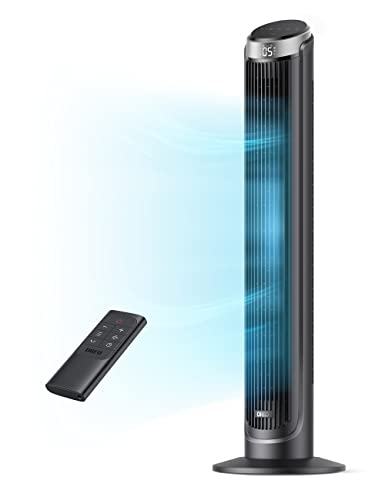
Best for: Quiet bedrooms and nighttime cooling. This 42-inch model uses TurboSilent technology to reduce noise to about 28 dB while delivering up to 26 ft/s airspeed and 1,473 CFM for quick cooling. It provides 5 speeds and 4 modes with a 12-hour timer. Caution: Higher wind speeds can be noticeable in very quiet rooms; use lower speeds for sleep.
KopBeau Personal Tower Fan

Best for: Small spaces, desks, and bedside use. This compact tower fan provides three speeds and a timer, plus dual oscillation options (60° focus or 110° full-room) to tailor airflow. Caution: Limited reach compared to larger towers; ideal for personal cooling rather than whole-room circulation.
Buying Guide
- Room size and airflow needs: Choose higher CFM and wider oscillation for large rooms; smaller rooms benefit from compact or personal towers with lower noise.
- Noise level: If quiet operation is priority, target models advertising 20–28 dB and consider Sleep/Night modes.
- Controls and convenience: Remote controls, touch screens, and programmable timers help maintain comfort without getting up.
- Modes and speed options: Look for multiple speeds and modes (Normal, Natural, Sleep, Auto) to cover daily cooling needs and energy use.
- Durability and stability: Floor-standing towers should have a solid base, stable height, and a reliable oscillation mechanism to prevent wobble.
- Filtration and safety: Bladeless or bladeless-like designs reduce risk around children and pets; verify tip-over safety if this matters.
Frequently Asked Questions
- What is the quietest tower fan? Answers vary by model; look for units rated around 20–28 dB and Sleep or Quiet modes for the lowest noise levels.
- Can tower fans cool an entire room quickly? Yes, larger towers with wide oscillation and higher CFM can circulate air more rapidly across a space.
- Are bladeless designs safer for homes with kids? Bladeless or bladeless-like fans reduce direct contact with blades and are generally considered safer for households with children.
- Do I need a timer on a fan? A timer helps automate cooling while saving energy and prevents overcooling at night.
- Is remote control necessary? Remote controls add convenience for bedrooms and living rooms where reaching the unit is inconvenient.
- What should I consider for office use? In an office, prioritize a balance of airflow, noise level, and a timer to avoid overcooling while working.