Best Duct Fans for HVAC: Quiet, Efficient Ventilation Options for Any Space
If you need to improve airflow through your HVAC ducts, these well-rounded duct fans offer strong performance, energy efficiency, and manageable noise. They’re suited for homeowners, renters, and small business spaces that require better ventilation in basements, kitchens, bathrooms, attics, grow tents, and workshops. The following picks emphasize reliability, ease of installation, and clear value across different duct sizes.
Summary of selected products:
- VIVOSUN 6 Inch Inline Duct Fan, 240 CFM (6″ diameter)
- VELLEE Quiet Register Booster Fan, 6″ x 10″ (6″ opening)
- Diversitech 625-AF10 Duct Fan, 10″ (650 CFM)
- Hon&Guan 6 Inch Inline Booster Duct Fan, 345 CFM
- Suncourt 10-Inch Inline Booster Duct Fan (DB210C), 300–650 CFM range
VIVOSUN 6 Inch Inline Duct Fan 240 CFM

Best for small-to-medium spaces where a compact, reliable airflow boost is needed. This 6-inch model delivers 240 CFM with a durable metal body and permanently lubricated bearings for quiet operation. It’s well suited for bathrooms, kitchens, attics, and basements with limited mounting space. A potential limitation is that higher airflow tasks in larger rooms may require a larger fan or multiple units.
- Best for: tight spaces needing solid ventilation without a big footprint
- Why selected: strong, maintenance-free motor; low noise; corrosion-resistant build
- Caution: 240 CFM may be insufficient for very large areas or high-heat applications
VELLEE Quiet Register Booster Fan

Best for improving airflow from wall or floor registers in year-round comfort projects. This 6″ booster operates with a smart sensor and multi-speed control, delivering up to 200 CFM while maintaining low noise. It’s ideal for homes seeking automatic adjustments and energy-conscious operation. The unit’s intelligence and 10-speed range help tailor performance to different seasons, though installation requires access to a suitable register cutout.
- Best for: automatic, energy-conscious airflow enhancement from registers
- Why selected: smart sensing, wide speed range, low noise
- Caution: may require precise cutout and wiring for optimal performance
Diversitech 625-AF10 Duct Fan

Best for larger ventilation tasks where robust airflow and straightforward installation are priorities. This 10″ unit delivers up to 650 CFM, making it suitable for workshops, garages, or commercial spaces needing strong air movement through ductwork. A key trade-off is its larger size and higher power draw; ensure ducting and space are adequate for installation.
- Best for: high-airflow requirements in larger spaces
- Why selected: high CFM, easy-to-mount package for duct systems
- Caution: larger footprint; higher energy use than smaller models
Hon&Guan 6 Inch Inline Booster Duct Fan

Best for quiet, energy-efficient boosting in bathrooms, kitchens, and small grow spaces. The 6-inch booster yields 345 CFM with a 19.2W DC motor, balancing air movement and electricity use. It’s well suited for continuous operation in occupied spaces but may be overkill for extremely small rooms where lower CFM is sufficient.
- Best for: quiet, energy-efficient boost in moderate spaces
- Why selected: high efficiency with low power draw, compact form
- Caution: 345 CFM may be more than needed for very small rooms
Suncourt 10-Inch Inline Booster Duct Fan

Best for rooms with strong back pressure in forced-air systems. The DB210C model increases airflow from 300 CFM to a maximum 650 CFM and is UL-listed in the United States. It’s a strong, versatile option for homes needing a substantial airflow boost without major HVAC modifications. A limitation is that performance depends on existing ductwork and system design.
- Best for: boosting airflow in larger rooms without major HVAC changes
- Why selected: wide CFM range, UL-listed design
- Caution: effectiveness depends on ductwork and system load
VIVOSUN 8 Inch Inline Duct Fan 420 CFM
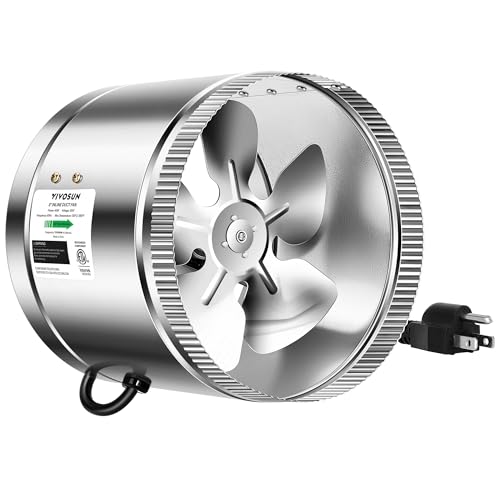
Best for mid-to-large spaces requiring substantial airflow with a reasonable footprint. The 8-inch model delivers 420 CFM with a durable metal body and a quiet bearing system. It suits basements, attics, and larger kitchens. It may be less ideal for very small spaces where an 6-inch unit would suffice.
- Best for: larger rooms that still require a compact 8″ fan
- Why selected: strong airflow, durable construction, low maintenance
- Caution: larger size than 6″ models; may not fit tight spaces
Buying Guide: Key Purchase Considerations
What size duct fan do I need? Choose by duct diameter and target airflow. A 6″ fan typically produces 200–300 CFM, while 8″ and 10″ models push 420–650 CFM. For rooms under 1000 sq ft with modest ventilation needs, a 6″ unit often suffices. Larger spaces or higher moisture and odor control may require bigger fans or multiple units.
What about noise and energy use? Look for models with low dB ratings and efficient motors. DC/EC motors generally deliver higher efficiency and quieter operation than older AC designs. If quiet operation is essential, compare dB levels and be mindful that higher airflow can increase noise unless mitigated by design features.
Is installation easy? Many inline duct fans come with standard mounting options and pre-wired connections. If you’re replacing an old unit, verify that ducting, power supply, and mounting points align. Booster fans designed for registers (like the 6″ models) may require precise cutouts and secure mounting for best results.
How will you use the fan? Consider whether you want automatic control (temperature sensor or smart features) or manual speed adjustments. Smart or sensor-based models save energy by tailoring operation to conditions, while manual controls offer straightforward operation without dependencies on apps or additional hardware.
What are common limitations? Larger fans require bigger ductwork and electrical capacity. Some models offer high CFM but are less efficient in smaller spaces due to backpressure or duct loss. Always confirm compatibility with your current HVAC layout and insulation levels.
FAQ
- What is CFM and why does it matter? CFM stands for cubic feet per minute and measures airflow. Higher CFM means more air moved, which is important for faster ventilation but may require larger ducting and more power.
- Do inline duct fans reduce humidity effectively? They improve air movement, which helps moisture control when paired with proper exhaust routes and dehumidification strategies, but fans alone aren’t a humidity cure.
- Are booster fans loud? Noise varies by model and speed. Look for low dB ratings and models designed for quiet operation if noise is a concern.
- Should I choose a 6″, 8″, or 10″ model? Base the choice on duct size, target CFM, and room size. Bigger is not always better if your ducting cannot support it or if space is limited.
- Can I install these myself? Many are DIY-friendly, but some require basic electrical work and secure mounting. If uncertain, consult a qualified professional.
- Do these fans require maintenance? Models with permanently lubricated bearings typically need less maintenance. Check the manufacturer’s guidance for inspection intervals and cleaning.