Best Data Center Air Conditioners for Reliable Server Room Cooling
Answering the common buying question for data centers and server rooms: choose portable or through-the-wall units designed for continuous operation, steady airflow, and easy maintenance. This guide highlights five top options that balance cooling capacity, installation flexibility, and space requirements. Best for compact tight spaces are window or portable units; better for larger or retrofit spaces are through-the-wall or industrial-style spot coolers. The following picks target small to mid-size data centers, server rooms, and equipment racks where reliable ambient cooling is essential. A quick buyer table is provided below to compare key attributes at a glance.
| Product | Type | BTU (approx.) | Best for |
|---|---|---|---|
| AmeriCool WMC-2500 | Industrial spot cooler | 10,000 | Server rooms, tight spaces, ceiling/hanging installations |
| LG 11,800 BTU Through The Wall | Through-the-wall | 11,800 | Large server rooms, persistent cooling needs |
| AGTANA 14000 BTU Portable | Portable | 14,000 | Open floor plans, movable cooling zones |
| EUHOMY 10,000 BTU Portable | Portable | 10,000 | Flexible cooling, dorms, small data rooms |
| Midea 10,000 BTU ASHRAE Portable | Portable | 10,000 | Smart control, remote operation for data spaces |
AmeriCool WMC-2500 Industrial Spot Cooler

The WMC-2500 is positioned for data centers and server rooms requiring flexible installation. Features include four installation options (portable, rack mountable, hanging, or stacked) to adapt to equipment layout. It is designed for high-demand environments with adaptable airflow distribution. Best for: server rooms needing versatility in positioning and space optimization. Better for: spaces where ceiling or rack mounting is feasible. Choose this if you need multiple mounting options to fit your rack or cabinet layout. Caution: hanging installs may require additional clearance and secure mounting to support weight.
LG 11,800 BTU Through-The-Wall

This LG wall unit is designed for through-the-wall installation, offering 3 cooling speeds and 3 pre-programmed modes to cool spaces up to 530 square feet. It uses R-32 refrigerant for efficiency and includes four-way air deflection for flexible airflow. Best for: mid-to-large data-center rooms with a wall-through mounting approach. Better for: spaces where window venting is impractical. Choose this if you want steady, room-wide cooling without occupying window space. Caution: through-the-wall installation is more permanent and may require professional mounting in some structures.
AGTANA 14000 BTU Portable Air Conditioner
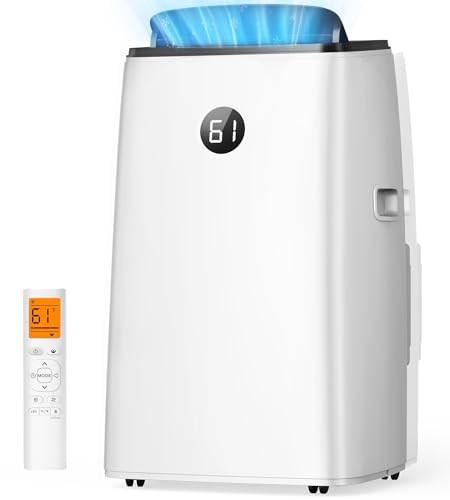
AGTANA offers a high-capacity portable unit suitable for larger spaces like data centers or open-plan rooms. It features 3 cooling settings, auto swing, and a self-evaporating system to reduce maintenance. Best for: large data rooms that require mobile cooling with strong airflow. Better for: temporary or flexible cooling zones that can be relocated as rack layouts change. Choose this if you need rapid cooling across a wider area. Caution: portable units may require more floor space and routine venting management to maintain efficiency.
Midea 10,000 BTU ASHRAE Portable

This Midea unit supports ASHRAE-rated 7,100 BTU SACC cooling in practice, delivering 10,000 BTU at peak. It includes smart control via an app, voice assistant compatibility, and a remote for easy operation. Best for: data center rooms needing remote management and flexible cooling schedules. Better for: spaces where integration with automation ecosystems is desired. Choose this if you want smart, app-controlled operation. Caution: portable design requires regular venting management and proper hose routing to avoid heat buildup around equipment.
LG 11,800 BTU Through-The-Wall (Second LG Option)

LG’s through-the-wall design is well-suited for server rooms needing substantial cooling with a durable install. It features R-32 refrigerant and a 3-speed, 3-mode profile to cover up to 530 sq ft effectively. Best for: high-density spaces where a fixed wall unit is preferred. Better for: installations where window units are not feasible. Choose this if you want robust, continuous operation with flexible airflow. Caution: installation may be more involved than a window unit and may require professional assistance.
Buying Guide
What cooling capacity do I need for a data center or server room?
Match BTU or tonnage to room size, heat load, and equipment density. Overcooling wastes energy; undercooling risks equipment overheating. For data centers, consider additional airflow plans and possible humidity control requirements.
Portable vs. fixed installations: which is better?
Portable units offer flexibility and quick deployment across zones but require ventilation and floor space. Fixed units (through-the-wall or hanging) provide stable cooling with less floor footprint and generally lower noise in dedicated spaces.
What about energy efficiency?
Look for units using efficient refrigerants (like R-32) and high SEER/EER ratings. In data centers, energy efficiency translates to lower operational costs and reduced thermal management strain on the overall infrastructure.
What maintenance should I plan for?
Routine filter cleaning or replacement, vent hose management for portable units, and regular coil cleaning help maintain performance. Self-evaporating features reduce moisture handling but still require periodic checks in humid environments.
Safety and installation considerations
Ensure proper mounting for fixed units, adequate clearances for airflow, and compliance with building codes. For through-the-wall installations, verify structural implications and the potential need for professional installation.
Which option is best for data center expansion?
Start with a fixed unit for baseline cooling and supplement with portable units to cover dynamic zones or contingencies. The goal is to balance stable ambient conditions with flexible cooling lanes for evolving equipment layouts.
Summary of key buying considerations
- Space: Wall-through units for fixed spaces; portable units for flexible zoning.
- Capacity: Align BTU with area heat load; plan for future expansion.
- Maintenance: Prioritize features that ease filter cleaning and moisture handling.
- Install: Consider ease of installation and need for professional help for fixed units.
- Automation: Smart controls can improve management across larger spaces.
FAQs
- What type of air conditioner is best for a data center?
- Can I use a household portable AC in a server room?
- Do I need professional installation for wall units?
- How important is refrigerant type for efficiency?
- How can I optimize energy use in a data center with these units?
- What maintenance scheduling is recommended?
Fixed through-the-wall or ceiling-hung units are common for stable ambient cooling, supplemented by portable spot coolers for flexible zones.
Yes, for non-critical, supplemental cooling or temporary relief, but ensure adequate airflow and hose management to avoid heat recirculation.
Yes, especially for through-the-wall installations to ensure structural integrity and proper venting.
Using modern refrigerants like R-32 improves efficiency and environmental impact, which is beneficial in cooling-heavy environments.
Combine fixed cooling with smart controls, schedule cooling during off-peak hours, and maintain air distribution to avoid hotspots.
Inspect and clean filters monthly, check hoses and seals, and perform coil cleanings as needed to maintain optimal performance.