Best Battery-Powered Register Booster Fans for Home Comfort
Answering the needs of homeowners seeking easier, wireless control of room airflow, battery-powered register booster fans provide targeted cooling and heating without permanent wiring. These units suit renters, small-space dwellers, and anyone seeking quick, energy-conscious improvements to airflow. This guide highlights five top options, explains who each is best for, and compares their key strengths and limitations.
| Product | Best For | Why It Stands Out |
|---|---|---|
| Howeall Super Quiet Register Booster Fan (White) | Smart homes with Wi-Fi control | Dual intelligent thermostat and app control for precise, remote management |
| Orabriz AC Vent Booster Fan | Small rooms needing quiet operation | 10-speed control with thermostat and remote |
| BIOWIND Quiet Register Booster Fan (White) | Quiet, reliable airflow | 10-speed smart control with stability upgrades |
| VIVOHOME Register Booster Fan | Versatile mounting in various rooms | Smart thermostat with remote, 4×10 opening compatibility |
| DEWENWILS Register Booster Fan | High airflow in larger spaces | Dual fans, fully closed design, 180° directional control |
Howeall Smart Register Booster Fan for 4″ x 10″ Openings

Best for smart-home enthusiasts who want precise airflow control via Wi-Fi and a companion app. This unit integrates with HVAC systems to balance temperatures and reduce energy waste. The dual control includes a straightforward button interface and remote app access.
Who it’s for: homeowners seeking automated comfort with mobile control and energy savings. Why selected: its 2026 upgrade and intelligent programming adjust fan speeds in real time, reducing manual adjustments and keeping rooms comfortable.
Caution: Ensure your register opening is compatible with 4″ x 10″ vents and confirm Wi-Fi availability for app control.
Orabriz AC Vent Booster Fan 4″ x 10″
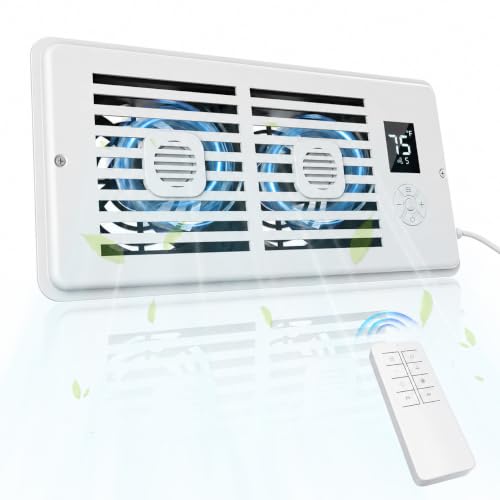
Best for small rooms that require solid air distribution with a remote, LCD display, and aroma pad option for a calmer environment. Ten speed levels and thermostat control support varied airflow needs and comfort levels.
Who it’s for: users who want flexible speed control and the option to add a pleasant scent. Why selected: it delivers reliable airflow improvements for compact spaces. Caution: installation may require careful cable routing for clean appearance.
BIOWIND Quiet Register Booster Fan (6″ x 10″)

Best for quiet, steady airflow in mid-sized registers with automated temperature sensing. The device includes stability upgrades for smoother operation and a clean, modern look that blends with home décor.
Who it’s for: those prioritizing quiet performance and reliable temperature-based activation. Why selected: smart LED controller and precise sensor help maintain balanced temperatures with automatic on/off control. Caution: verify that 6″ x 10″ is the correct opening size for your register.
VIVOHOME 4” x 10” Register Booster Fan

Best for flexible installation across floors, walls, or ceilings with a compact 4×10 opening. Features a built-in thermostat and seven temperature presets to automate airflow according to room conditions.
Who it’s for: renters or homeowners needing versatile mounting and a quiet but powerful boost. Why selected: EC motor with up to 120 CFM airflow and a “fan only” mode for overnight use. Caution: ensure the vent opening length matches standard measurements before purchasing.
2026 Howeall Smart Register Booster Fan ORB

Best for households seeking the latest smart features and remote control. This model mirrors the 2026 Howeall design with dual control, intelligent programming, and Wi-Fi app support, optimized to balance temperatures efficiently.
Who it’s for: users who want up-to-date, app-based control with energy savings. Why selected: 2026 upgrades provide refined speed adjustments and automatic on/off timing for cost savings. Caution: ensure compatibility with your register size and home network setup.
BIOWIND Quiet Register Booster Fan (6″ x 10″)

Best for consistent comfort with minimal noise in standard-sized rooms. It features the same stability and precision control found in BIOWIND products, with a focus on quiet operation and smooth airflow.
Who it’s for: quiet-loving buyers who still want strong airflow. Why selected: proven design for balanced temperatures and automatic on/off based on room conditions. Caution: confirm your register can accommodate 6″ x 10″ units.
DEWENWILS 4″ x 10″ Register Booster Fan

Best for large-room airflow with high CFM and flexible airflow direction. This model uses dual high-airflow fans and a fully closed design to minimize unwanted drafts when not in use.
Who it’s for: spaces requiring stronger cooling or heating push, such as larger living areas or home offices. Why selected: 180-degree adjustable louvers offer precise airflow targeting. Caution: higher airflow can be noisier on lower settings; consider location and speed selections carefully.
Buying Guide
What size is right for your register? Measure opening dimensions and compare to each unit’s listed openings (commonly 4″ x 10″ or 6″ x 10″).
How do you want to control airflow? Decide between manual button control, remote, or Wi-Fi app control. Wireless options provide easier scheduling and energy awareness.
What level of noise is acceptable? Look for EC motor technology and dB ratings if available. Quiet operation is important in bedrooms and study spaces.
Do you need ambient features? Aromatherapy pads, LEDs, or remote temperature sensing can enhance comfort but add complexity.
What mounting options are needed? Some units support floor, wall, or ceiling installation. Verify compatibility with your space before purchase.
FAQ
- What size register booster fan should I buy? Choose a unit matching your register opening, typically 4″ x 10″ or 6″ x 10″.
- Do these fans require professional installation? Most are designed for simple DIY installation, but follow the included instructions for wiring and mounting safety.
- Can these fans improve energy efficiency? Yes, by delivering conditioned air more directly to rooms, they can reduce the need for whole-house cooling or heating.