Best Air Conditioning for Warehouse
Finding the right cooling solution for a warehouse depends on space size, required airflow, and whether you need spot cooling or whole-area comfort. The top options below balance portability, power, and durability for commercial settings. This guide highlights five portable or evaporative units best suited for warehouses, workshops, and storage areas. It helps buyers choose by room size, noise, and operating costs, with clear pros and cons for each scenario.
| Product | Best For | Key Strength |
|---|---|---|
| 10,000 BTU Portable Air Conditioner (Air Future) | Medium to large offices adjacent to warehouses | 3-in-1 cooling, dehumidification, and fan with remote |
| Auertech 8000 CFM Swamp Cooler | Very large open spaces or outdoor-adjacent areas | High airflow, water-tank driven evaporative cooling |
| Air Choice 10000 BTU Portable AC | Apartments, retail bays, or smaller warehouse corners | Quiet sleep mode and versatile window-kit setup |
| Air Future 10,000 BTU Portable AC (Second Model) | Similar to first unit in bounded spaces | 3-in-1 with remote convenience |
| ANTEQUIP 6000 BTU Industrial Spot Cooler | Localized, point-by-point cooling near machinery | Industrial-focused spot cooling, low-noise operation |
Air Future 10,000 BTU Portable AC With 3-in-1 Function

This 10,000 BTU unit is designed for spaces up to 450 square feet, delivering strong cooling with a maximum airflow of 240 CFM. It functions as an air conditioner, dehumidifier, and fan, making it versatile for semi-enclosed warehouse corners or office-adjacent areas. The remote control and 24-hour timer support convenient scheduling, while the window kit allows quick, tool-free setup in common sliding or fixed windows. Best for: mid-sized workshop bays or office spaces near a warehouse. Caution: performance may vary in extremely high humidity environments where evaporative cooling is less effective.
Auertech 8000 CFM Swamp Cooler For Large Areas

This evaporative cooler delivers robust airflow with an 8000 CFM rating and 45 feet per second wind speed. It’s built around a large 30-gallon water tank and includes eight ice packs to extend cooling performance in hot warehouses or open workshop floors. The unit is mobile with wheels and a simple control panel, making it better for outdoor or semi-outdoor spaces, garages, or factories where fresh air circulation is key. Best for: expansive or well-ventilated warehouse zones needing high-volume air movement. Limitation: evaporative cooling requires dry air and may be less effective in already humid conditions.
Air Choice 10000 BTU Portable AC For 450 Sq.Ft

With 10,000 BTU cooling, this Air Choice model centers on quiet operation and scheduling. It includes a no-drill window kit suitable for apartments or rental warehouses, with a two-section kit suitable for window widths from 25.6″ to 50″. Sleep mode and a 24-hour timer help align cooling cycles with work shifts, while a remote enhances ease of use in busy environments. Best for: warehouse corners that require flexible setup and quieter operation. Caution: window kit compatibility varies by window style; verify fit before installation.
Air Future 10,000 BTU Portable AC (Second Model)
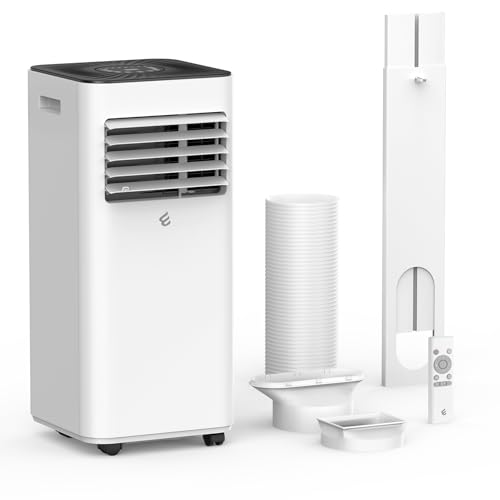
This 10,000 BTU unit emphasizes 3-in-1 functionality—cooling, dehumidifying, and fan modes—paired with a wide 61°F to 90°F cooling range. The large, easily readable digital display and remote control support streamlined operation in warehouse offices or break rooms. Best for: spaces needing flexible climate control with straightforward operation. Caution: similar performance to other 10k models; compare energy use across units for longer shifts.
ANTEQUIP 6000 BTU Industrial Spot Cooler

Designed for focused cooling near workstations or machinery, the 6000 BTU spot cooler emphasizes targeted airflow rather than whole-room cooling. It features a copper cooling system and an R32 refrigerant for efficient localized cooling with lower noise. Best for: operators at hot machines or workstations that need direct, point-by-point relief. Limitation: not ideal for large open warehouse areas where uniform cooling is required.
Buying Guide: Key Considerations for Warehouse Cooling
- Space planning: Determine whether you need whole-area cooling or spot cooling near heat sources. Open bays benefit from high-CFM evaporative units, while smaller zones may prefer compact portable ACs.
- Airflow and coverage: Look for CFM ratings or airflow specs to match the target square footage. Higher CFM units are better for larger spaces but may consume more power.
- Power and installation: Portable units with simple window kits simplify setup in rented spaces. Check electrical requirements and any venting needs to avoid safety hazards.
- Climate considerations: Evaporative swamp coolers work best in dry environments; refrigeration-based units perform reliably across humidity levels but may require venting and drainage.
- Noise and shift timing: For occupied offices or break rooms, select models with sleep modes or low-noise operation to minimize disruption during night shifts.
Frequently Asked Questions
- What type of cooling is best for large warehouses?
Evaporative swamp coolers offer high airflow for open spaces, while portable AC units deliver targeted cooling where needed.
- Do I need a window kit for warehouse cooling units?
Many portable ACs include window kits for venting exhaust. If you rent or can’t modify walls, these kits provide a practical installation option.
- Can portable cooling units handle continuous operation?
Yes, but check the unit’s duty cycle, drainage needs, and filter maintenance to sustain efficiency over long shifts.
- Is higher BTU always better for warehouses?
Not necessarily. Coverage area, ceiling height, and air exchange rate influence effectiveness. Oversized units may waste energy.
- How does humidity affect evaporative coolers in warehouses?
Evaporative coolers rely on dry air; high humidity reduces effectiveness, making refrigerated options preferable in humid climates.