Best 240V Heating Element Controller Guide: Top Picks for DIY Projects
Answering the buyer’s search, these 240V heating element controllers and compatible components are chosen for reliability, ease of use, and clear setup instructions. This guide targets hobbyists and professionals working on home brewing, water heating, or spa projects who need precise power control at 240V. The top selections include a versatile PID controller kit, a dual-stage thermostat, a precision power controller, and dependable high-wattage elements for compatible 240V systems. The following table highlights the featured products and their core strengths for quick reference.
| Product | Best For | Why It Stands Out |
|---|---|---|
| CGele PID Temperature Controller Kit | Home brewers, lab hobbyists | Comes with SSR, thermocouple, and heat sink for ready-to-wire control |
| bayite BTC211 Dual Digital Outlet Thermostat | Multi-zone heating/cooling | Dual relays, simple plug-and-play setup, 110–240V |
| Blichmann Electric Element Power Controller | Precise power control for heating elements | 0–100% control with fast response, table or wall mounting |
| Rheem SP10552MH 240V Heating Element | Replacement heater elements | High-wattage 4500W for 240V systems |
| HE 90240 9KW 240V Heating Elements (3-pack) | High-power tankless setups | Copper elements with high-temperature tolerance for 240V |
CGele PID Temperature Controller Kit
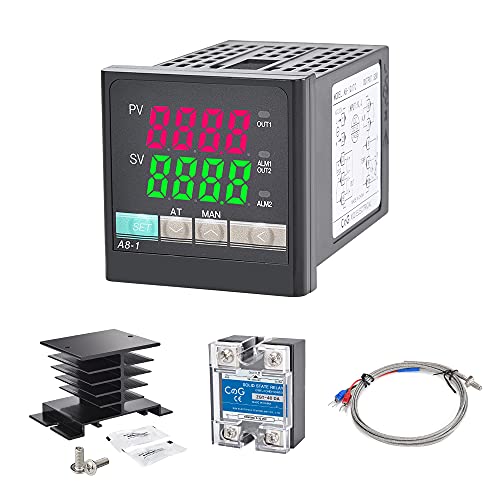
The CGELE kit features a PID temperature controller with one alarm relay output (AC220V/DC30V 3A) and supports 3-wire or 2-wire sensors, including K, E, J, N, and PT100 types. It includes a 40DA SSR output, enabling external SSR control for precise heating regulation. Best for hobbyists building compact heating or fermentation systems where accurate temperature maintenance matters. Choose this if you want an all-in-one package with a built-in SSR option and broad sensor compatibility. A limitation is the need for proper wiring and electrical knowledge to integrate the SSR safely.
Bayite BTC211 Dual Digital Outlet Thermostat
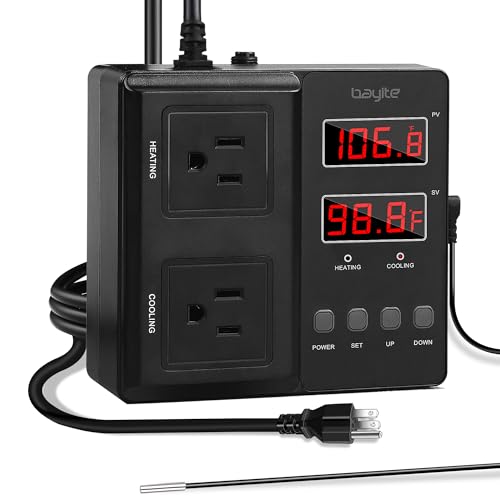
Bayite BTC211 provides two digital outlets with separate heating and cooling control. It supports 110V–240V and displays real-time temperature and setpoint, making it ideal for two-stage heating and cooling setups like fermentation chambers or terrarium systems. Best for users needing independent control channels and a straightforward plug-and-play experience. Better for simple dual-zone projects; not a single-zone, continuous PID control, which may be a limitation for some precision applications.
Blichmann Electric Element Power Controller – 240V

The Blichmann controller offers precise power modulation from 0% to 100% with a fast-acting knob and is optimized for table or wall mounting. It does not measure temperature itself, but it excels at delivering steady power to heating elements in 240V systems. Best for users who want granular control of heater power without embedded temperature feedback. Choose this if your system already uses a separate temperature sensor and you need reliable, repeatable power delivery. A potential limitation is the lack of built-in temperature sensing.
Rheem SP10552MH 240V Heater Element

Rheem SP10552MH is a 4500W resistored heating element designed for 240V water heating systems. It is a direct replacement option when upgrading or repairing compatible Rheem setups. Best for restoring high-output water heating performance. It’s important to confirm compatibility with the existing tank and electrical wiring due to wattage and voltage requirements. A limitation is that it is a heater element rather than a controller; integration with a separate controller is necessary for temperature management.
HE 90240 9KW 240V Heating Elements (3-Pack)

This set includes three 9KW heating elements rated for 240V, suitable for high-demand tankless or large-volume heating configurations. Best for installations requiring significant heating capacity and reliable copper elements with corrosion and high-temperature tolerance. Use caution with high current draw and ensure wiring meets electrical codes. A limitation is the need for correct harnessing and secure terminal connections to manage high power safely.
Buying Guide
What should you consider when selecting a 240V heating element controller?
- Controller type: Do you need full PID temperature control, dual-stage on/off control, or simple power modulation? Your choice affects accuracy and system complexity.
- Power capacity: Ensure the controller’s output and any external relays match your heating element wattage and wiring capacity. Oversized loads require sturdy wiring and appropriate breakers.
- Sensor compatibility: Look for support for common thermocouples or RTD sensors (K, J, PT100, etc.) to fit your temperature-sensing needs.
- Mounting and enclosure: Consider where the controller will be installed. DIN-rail mounting and back cable routing offer neat installation options.
- Safety and alarms: Alarm outputs, overheat protection, and proper isolation are essential for safe operation in DIY projects.
What are typical use cases?
- Home brewing or fermentation chambers needing stable temperatures.
- Spa or hot tub heater installations requiring regulated heat input.
- Water heating or tankless systems where quick, reliable heat control is necessary.
What are potential limitations to watch for?
- Some controllers require electrical knowledge for wiring SSRs and thermocouples safely.
- Not all units include temperature sensing; pairing with a separate sensor is common.
- Higher-wattage elements demand careful attention to wiring gauges, connectors, and breaker sizing.
Frequently Asked Questions
Q: What is the main advantage of a PID controller for 240V heating elements?
A: PID controllers minimize overshoot, provide stable temperature control, and can maintain precise setpoints with variable heat input.
Q: Do I need an alarm on my controller?
A: An alarm helps alert you to temperature excursions or sensor faults, improving safety and reliability in continuous operation.
Q: Can I use any heating element with a PID controller?
A: Yes, as long as the element’s wattage and impedance are compatible with the controller’s outputs and the external SSR or relay requirements.
Q: Is a dual-relay controller better than a single-relay model?
A: Dual relays enable simultaneous control of heating and cooling devices, which is advantageous for processes requiring both heat and chill cycles.