Best 12V RV Air Conditioner for Off-Grid Comfort on the Road
If you’re seeking reliable 12V RV air conditioning, these units are designed for off-grid power and easy installation. They target campers, van dwellers, truckers, and boaters who want climate control without a full 120V inverter setup. This guide highlights five top options, explains who each is best for, and compares cooling, heating, energy use, and noise. Use the buying guide to decide which model fits your battery bank, solar plan, and travel style.
Product snapshot: the following table highlights key attributes to help compare at a glance. Clickable product headings link to the Amazon listing for each unit.
| Product | BTU (Cool / Heat) | Best For | Notes |
|---|---|---|---|
| Gidrox 10000 BTU 12V DC RV A/C (No Heater) | 10000 cool / heater via separate option | Off-grid campers needing quiet, battery-friendly cooling | Low power consumption, app remote |
| iHooToo 12V RV A/C 10000 BTU | 10000 cool / built-in smart controls | Tech-savvy RV owners wanting voice/app control | Bluetooth app, dual-rotor compressor |
| Somokg 11000 BTU 12V A/C | 11000 cool / off-grid capable | Quiet operation with strong cooling | Ultra-quiet at 35dB |
| Gidrox 12000 BTU 12V A/C with Heat Pump | 12000 cool / 9000 heat | Year-round comfort in diverse climates | Heat pump adds heating efficiency |
| Outequip 12V 10000 BTU A/C with Heater | 10000 cool / 4500 heat | Compact rigs needing heater boost | Durable, weather-resistant build |
Gidrox 10000 BTU 12V A/C With Heater (App Remote)

Best for off-grid vans needing quick comfort and battery-friendly operation. This unit runs on 12V DC directly from an RV battery, avoiding inverter use and delivering roughly 350W in typical nighttime operation. It’s known for low energy draw and quiet performance, with three modes: Turbo, ECO, and Sleep. It supports fast cooling and heating via its integrated PTC technology, letting you reach comfortable temperatures within minutes. A caution: the heater is part of a separate system in some configurations, so verify your installation needs before purchase.
iHooToo 12V RV A/C With Voice & App Control
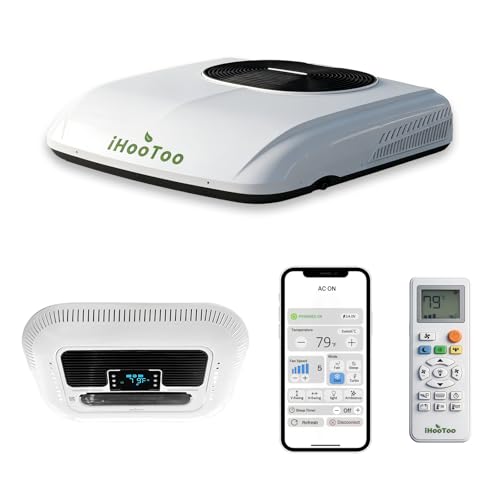
Best for tech-friendly travelers who want flexible control. This 12V unit offers voice control, a Bluetooth app, and infrared remote, plus physical controls on the panel. It uses a dual-rotor quiet compressor for strong cooling performance and maintains efficiency in high heat. It also supports off-grid play with an integrated control system and low-voltage protection to extend battery life. Limitations include the need for compatible solar or battery capacity to sustain long nights without a recharge.
Somokg 11000 BTU 12V A/C for Off-Grid
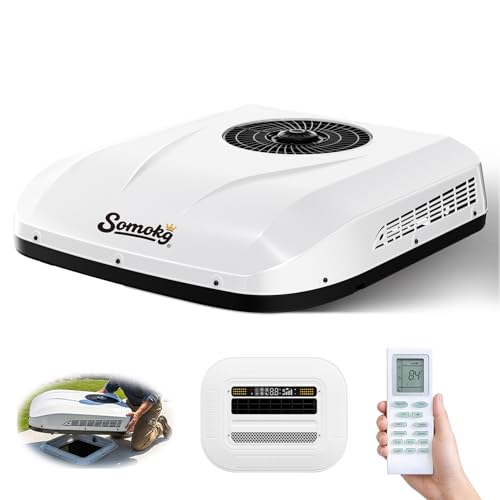
Best for larger campers seeking robust cooling with quiet operation. It delivers about 11,000 BTU cooling and uses an integrated soft start to reduce startup surges, which helps conserve battery life when off-grid. It can run on solar or generator power and aims for up to 12 hours of cooling in sleep-friendly configurations with a 480Ah battery. A potential limitation is that taller air distribution or ducting might be needed in some layouts for optimal airflow.
Gidrox 12000 BTU 12V A/C With Heat Pump
Best for year-round use where heating is needed without a separate heater, thanks to its heat pump delivering approximately 9,000 BTU of heat and 12,000 BTU of cooling with high efficiency (EER up to 12.3). It maintains low noise (Sleep mode at about 40dB) and has the same 12V power approach as other Gidrox units. Choose this if you want a single 12V system that handles both seasons. Limitation: heat pump performance can vary in very cold conditions; verify compatibility with your climate expectations.
Outequip 12V 10000 BTU A/C With Heater

Best for compact rigs needing reliable cooling with an auxiliary heat option. This unit cools efficiently in about 15 minutes and includes a 4,500 BTU heater to provide extra warmth when conditions are mild. Built with UV-stabilized ABS, EPDM foam gasket, and a zinc-coated condenser, it’s designed to withstand weather exposure. A caution: heater capability is supplementary; do not rely on it as the primary heat source in harsh cold.
Buying Guide: Key Considerations For Selecting A 12V RV Air Conditioner
- Power compatibility: Confirm your RV battery bank and whether you plan to use solar. 12V systems with higher Ah ratings support longer off-grid use.
- BTU needs: Match cooling capacity to your space size. Larger rigs benefit from 11000–12000 BTU, while small campers may be comfortable with 10000 BTU.
- Heating options: Decide if you want integrated heating (heat pump) or a separate heater. Heat pumps save energy but performance drops in very cold conditions.
- Noise level: Look for units with 35–40 dB sleep-mode performance to minimize disturbance at night.
- Smart controls: Voice, app, or remote control can simplify operation when parked or driving.
- Installation footprint: Low-profile designs ease rooftop mounting; verify compatibility with your RV roof and existing vent openings.
- Durability and weather resistance: UV-stable shells and gasket materials extend life in varied climates.
Additional Buying Tips
- Plan for off-grid runtime: Estimate nightly cooling hours and total energy drain to size your battery bank and solar array.
- Consider future expandability: If you anticipate adding solar or a larger battery, choose a unit with good efficiency and protection features.
- Installation ease: Some brands offer built-in controls and integrated systems that streamline wiring and setup.
FAQ
- Q: Can a 12V RV AC run off a standard portable solar battery system? A: It depends on battery capacity and solar input. Look for models with low continuous power draw and effective low-voltage protection.
- Q: Do heat pumps work well in cold weather? A: Heat pumps provide heating efficiently in moderate cold but may lose efficiency in very cold conditions; plan for additional heating if needed.
- Q: Is a separate heater necessary if a unit has a heat pump? A: Not strictly, but a heater may provide backup warmth in extreme cold or when outside temperatures drop significantly.
- Q: How quiet are these units? A: Many models target 35–40 dB in Sleep mode, which is among the quieter options for rooftop units.
- Q: What should I verify before purchase? A: Verify BTU needs, power requirements, compatibility with your roof, and whether off-grid operation aligns with your battery system.